


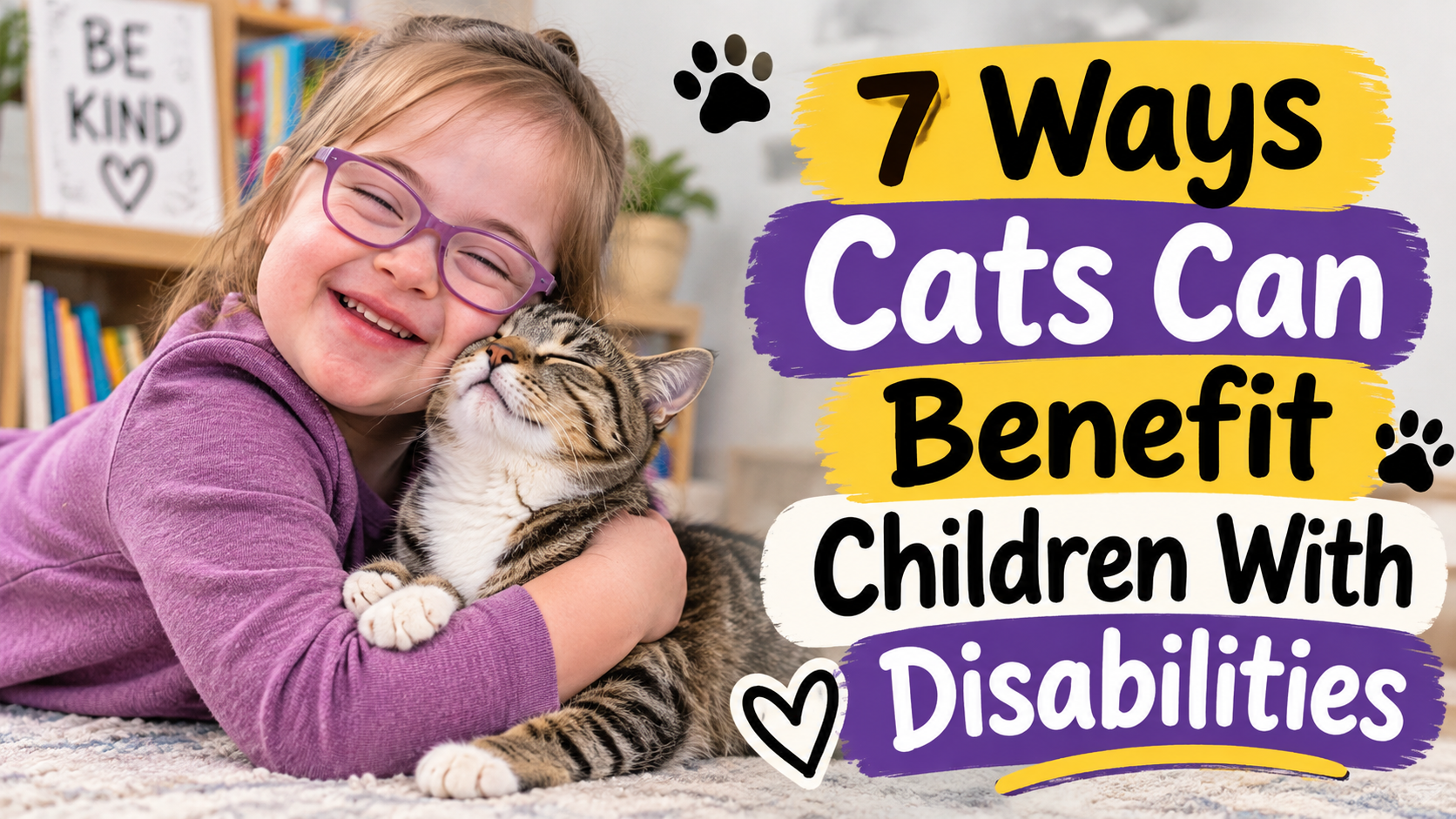
Could bringing a cat into your home make a positive difference in your child’s life?
For families raising children with autism, ADHD, developmental delays, sensory differences, or other disabilities, finding the right family pet can be an important decision. Parents often look for an animal that can provide companionship, encourage responsibility, and become a comforting part of the household.
While dogs are often the first animals people think of when discussing pets for children with special needs, cats deserve consideration too.
Cats can offer affection, companionship, opportunities to practice social skills, and a chance for children to participate in caring for another living creature. Their individual personalities and routines may also make them a good fit for some families.
But are cats actually good pets for children with disabilities? The answer depends on the child’s needs, the cat’s temperament, and the family’s ability to provide proper care.
Let’s explore seven potential benefits of having a cat, what parents should consider before adopting one, and how to create a safe and positive relationship between a child and their new feline companion.
Are Cats Good Pets for Children With Disabilities?
Yes, cats can be wonderful pets for some children with disabilities. They may provide companionship, opportunities to practice gentle interactions, and a meaningful relationship that develops over time.
However, not every child will enjoy having a cat, and not every cat will be comfortable around children.
The most important factor is finding an animal whose personality, energy level, and needs are compatible with your household.
Research into human-animal relationships is continuing to grow. A 2026 Oregon State University study examined a structured cat-training program involving 36 children with developmental disabilities between the ages of 8 and 17. The researchers reported increased caregiving responsibility among participating children and improvements in the cats’ social behavior.
This is promising early research showing that cats can participate in meaningful relationships with children with developmental disabilities. It does not mean that owning a cat is a treatment for a disability or that every child will experience the same outcomes.
With that in mind, here are seven reasons families may want to consider a cat.
1. Cats Can Provide Comfort and Companionship
One of the most meaningful things a pet can offer a child is companionship.
Children with disabilities may sometimes experience social isolation, difficulty connecting with peers, or frustration when communicating their feelings. Having a familiar animal nearby can provide another source of connection within the home.
Cats may show affection in different ways. Some enjoy sitting beside their owners, curling up on a lap, following family members around the house, or purring when they are comfortable.
For a child who enjoys quiet companionship, a gentle cat may become a welcome part of their daily routine.
A cat does not expect a child to communicate in a particular way. Children can enjoy spending time with an animal through petting, watching, playing, or simply sitting nearby.
Parent tip: Never force a child or cat to interact. Allow the relationship to develop naturally, and give both the child and the animal the freedom to take a break.
2. A Cat’s Calm Personality May Be a Good Fit for Some Children With Sensory Differences
Some children with sensory sensitivities prefer quieter environments and may become overwhelmed by sudden sounds, unpredictable movements, or highly energetic play.
Depending on the individual animal, a cat may be a comfortable companion because many cats enjoy resting, observing their surroundings, and spending time in familiar spaces.
Unlike dogs that typically need outdoor walks, cats can often get their exercise through indoor play and exploration.
However, cats are not always quiet or predictable. They may run around suddenly, knock objects over, scratch furniture, vocalize, or become uncomfortable when touched.
When choosing a cat, look for one that is comfortable around children and does not become easily frightened by ordinary household activity.
Parent tip: Create a quiet space where your cat can retreat whenever it wants. This is especially important for households with children who may have difficulty recognizing when an animal needs space.
3. Caring for a Cat Can Help Children Practice Responsibility
Having a pet gives children opportunities to participate in everyday caregiving activities.
Depending on their abilities and age, children may be able to help:
- Put food into the cat’s bowl with adult supervision.
- Refill a water bowl.
- Help select toys.
- Brush the cat gently.
- Put cat toys away.
- Help organize pet supplies.
- Participate in simple training activities.
These small activities can become meaningful routines.
For a child who is working on independence, following directions, sequencing tasks, or completing daily routines, participating in age-appropriate pet care can provide opportunities to practice those skills.
For example, a parent could create a visual checklist showing the steps for feeding the cat:
- Get the cat’s food container.
- Ask an adult for help.
- Put the correct amount of food in the bowl.
- Place the bowl in the feeding area.
- Wash your hands.
Children should not be expected to take full responsibility for an animal. Adults must remain responsible for feeding, veterinary care, litter box cleaning, and the cat’s overall safety and well-being.
4. Cats Can Create Opportunities to Practice Social Skills
Social interaction can be challenging for some children with autism, communication differences, or other developmental disabilities.
A family cat may provide opportunities to practice important interaction skills in a familiar environment.
For example, children can practice:
- Approaching an animal gently.
- Waiting for the cat to come closer.
- Recognizing when another living creature needs space.
- Taking turns during play.
- Using gentle movements.
- Responding to another being’s behavior.
- Showing patience and kindness.
A cat’s body language can also create opportunities for parents to discuss communication that does not involve spoken words.
For example, a parent can explain that a cat with flattened ears, a moving tail, or an attempt to move away may be uncomfortable.
These interactions can help children learn to observe and respond to another living creature’s signals.
Parent tip: Turn these moments into simple learning opportunities. Ask your child questions such as, “What do you think the cat is telling us?” or “How can we show the cat that we are being gentle?”
5. Cats May Encourage Emotional Awareness and Empathy
Learning to understand emotions is an important part of development.
Children can practice empathy by noticing how an animal responds to different situations and learning to respect its feelings.
For example:
- If the cat is sleeping, let it rest.
- If the cat walks away, do not chase it.
- If the cat approaches, offer a gentle hand.
- If the cat appears frightened, give it space.
- If the cat wants to play, use an appropriate toy.
These everyday experiences provide opportunities to discuss kindness, patience, boundaries, and caring for another living creature.
A cat cannot replace professional emotional or behavioral support, but the relationship may become a meaningful part of a child’s home life.
6. Cats Can Encourage Play and Shared Family Activities
Cats can be playful, curious, and entertaining.
Playing with a cat can give children and parents opportunities to spend time together while encouraging gentle movement and interaction.
Depending on the child’s abilities and the cat’s preferences, activities may include:
- Moving a wand toy for the cat to follow.
- Rolling a lightweight ball.
- Hiding toys for the cat to discover.
- Creating simple cardboard play structures.
- Watching the cat explore a puzzle feeder.
- Practicing basic reward-based training with adult guidance.
These activities can also be adapted for children with motor, communication, or developmental differences.
For example, a child who has difficulty holding a small toy might use a larger handle or participate by pointing to the toy they want an adult to move.
The goal is not to make the cat perform tricks or participate in activities it dislikes. The goal is to create enjoyable experiences for both the child and the animal.
7. Cats Can Become Long-Term Family Companions
Bringing a cat into the family can create a relationship that lasts for many years.
As a child grows, their relationship with the family cat may change. A young child might initially enjoy watching the cat play, while an older child may become more involved in feeding, grooming, playtime, or training.
A familiar pet can also become part of the family’s everyday routines and traditions.
However, adopting a cat is a long-term commitment. Cats can live for many years, and families should be prepared to provide food, veterinary care, enrichment, and a safe home throughout the animal’s life.
Before adopting, consider whether your family has the time, finances, and resources to care for a cat long term.
What Is the Best Cat for a Child With Special Needs?
There is no single cat breed that is best for every child with disabilities.
A cat’s individual temperament is usually more important than its breed.
Some families may prefer an affectionate cat that enjoys being around people. Others may do better with an independent cat that likes spending time nearby without constant physical contact.
When meeting a potential family pet, look for an animal that:
- Appears comfortable around people.
- Has a temperament suitable for your household.
- Can tolerate normal household activity without becoming highly distressed.
- Has a history of positive interactions with children, when known.
- Is comfortable with the level of interaction your child may want.
- Has no known behavior concerns that would make the match unsafe.
An adult cat with an established personality may be easier for some families to evaluate than a very young kitten. Kittens can be energetic and may scratch or bite during play.
Ask the shelter or rescue organization about the cat’s behavior, health history, and experience living with children.
Remember: A gentle personality matters more than choosing a particular breed or appearance.
Are There Hypoallergenic Cats for Children With Allergies?
This is an important question for families considering a cat.
Some cat breeds are marketed as hypoallergenic, but no cat breed is guaranteed to be allergy-free.
Cat allergens can be found in substances such as saliva and skin flakes, not just fur. Even cats that shed less can trigger allergic reactions.
If your child has asthma, allergies, or a history of reactions around cats, speak with their healthcare professional before bringing a cat into your home.
The American Academy of Pediatrics provides guidance about pet allergies and children.
You can read more here:
Important Safety Tips for Children With Disabilities and Cats
Although cats can be wonderful companions, parents should consider safety before bringing one into the home.
Children with limited communication, difficulty recognizing boundaries, sensory-seeking behaviors, or challenges with impulse control may need additional support when interacting with animals.
Here are important precautions.
1. Always Supervise Interactions When Needed
Never assume a child and cat will automatically understand one another.
Supervise interactions based on your child’s age, abilities, and the cat’s behavior. Children who may grab, chase, squeeze, or unintentionally frighten an animal need close adult guidance.
2. Teach Gentle Touch
Show your child how to gently pet the cat, preferably along its back or another area the cat comfortably accepts.
Avoid pulling the tail, grabbing paws, squeezing, or touching the cat’s face without the animal’s permission.
3. Give the Cat a Safe Place
Cats need a place where they can rest without being disturbed.
Consider providing a quiet room, cat tree, elevated resting area, or comfortable bed that your child knows is off-limits.
4. Watch for Signs of Stress
Teach your child to recognize when the cat needs space.
Signs may include:
- Flattened ears.
- Tail swishing or thumping.
- Hissing or growling.
- Moving away or hiding.
- A tense body posture.
- Attempts to scratch or bite.
If you notice these behaviors, calmly separate the child and cat.
5. Keep Up With Veterinary Care
Cats need routine veterinary visits, vaccinations, parasite prevention, and general health monitoring.
A healthy-looking cat can still carry germs that may spread to people.
The CDC recommends washing hands after handling cats, their food and water dishes, or their supplies. It also advises adults to supervise young children around animals and take precautions to prevent scratches and bites.
Read the CDC’s cat safety guidance:
https://www.cdc.gov/healthy-pets/about/cats.html
6. Keep Litter Boxes Away From Children
Adults should manage litter box cleaning and keep litter boxes away from food preparation areas and places children play.
Wash hands after handling cat supplies or cleaning the litter box.
7. Teach Children What to Do if They Get Scratched or Bitten
Even a small cat scratch or bite can become infected.
Teach your child to tell an adult immediately if a cat scratches or bites them. Wash the wound with soap and running water and seek medical advice when appropriate, particularly for bites, deep scratches, or signs of infection.
Are Cats Better Than Dogs for Children With Disabilities?
Not necessarily. Cats and dogs offer different experiences, and the best choice depends on the child and family.
| Cats | Dogs |
|---|---|
| Often enjoy independent rest and play | Often need regular walks and outdoor exercise |
| Can be suitable for indoor living | Usually need more outdoor activity |
| May enjoy quiet companionship | May enjoy more active interaction |
| Can use litter boxes | Need regular bathroom breaks |
| May be a good fit for families seeking a more independent pet | May be a good fit for families seeking an active companion |
Some children may prefer a cat because they enjoy quiet environments and less physical interaction. Other children may prefer a dog because they enjoy outdoor activities, games, and more active companionship.
Neither animal is automatically better for children with disabilities.
Also, a regular household cat is not the same as a trained service animal or therapy animal. If your child needs a specific disability-related service, speak with qualified professionals about appropriate options.
How to Introduce a Cat to Your Child
Once you have chosen a suitable cat, take time to introduce the animal to your child.
A slow introduction can help everyone become comfortable.
Step 1: Talk about the new pet before bringing it home.
Use pictures, books, or short videos to show your child what living with a cat may look like.
Step 2: Prepare the cat’s space.
Set up food, water, a litter box, scratching materials, toys, and a quiet resting area before the cat arrives.
Step 3: Allow the cat to explore.
Give the cat time to adjust to its new environment. Avoid immediately encouraging your child to hold or cuddle it.
Step 4: Introduce short interactions.
Allow your child to observe the cat and interact gently when the animal is comfortable.
Step 5: Establish a predictable routine.
Create simple routines for feeding, playtime, and quiet time. Visual schedules can help children understand what to expect.
Step 6: Celebrate gentle interactions.
Praise your child for waiting, using gentle hands, respecting the cat’s space, and following safety rules.
The goal is to develop a relationship based on trust rather than forcing the cat to interact.
Frequently Asked Questions About Cats and Children With Disabilities
Are cats good pets for children with autism?
Some autistic children enjoy cats because they can provide companionship and opportunities for gentle, predictable interactions. However, individual preferences vary. Consider your child’s sensory needs, communication abilities, and comfort around animals before adopting.
Can cats help children with special needs emotionally?
Cats may provide companionship and emotional comfort for some children. Research on human-animal relationships is growing, but a pet should not be considered a replacement for medical care, therapy, or other professional support.
Do cats help children with autism develop social skills?
Interacting with a cat may provide opportunities to practice patience, turn-taking, observing body language, and respecting boundaries. A 2026 study of a structured cat-training program involving children with developmental disabilities reported promising findings related to caregiving responsibility and child-cat relationships. More research is needed to understand how broadly these results apply.
Are cats easier to care for than dogs?
Cats often do not require outdoor walks like dogs, but they still need daily feeding, fresh water, litter box cleaning, play, veterinary care, and attention. They are not maintenance-free pets.
What age should a child be before getting a cat?
There is no universal age. Consider the child’s maturity, communication, ability to follow safety instructions, and the cat’s temperament. Younger children and children who need additional supervision should not be left alone with a cat.
What is the best cat breed for a child with autism?
There is no scientifically established best breed for autistic children. Look for an individual cat with a temperament that matches your child’s preferences and your family’s lifestyle.
Can a cat be an emotional support animal for a child with a disability?
A cat may provide emotional comfort and companionship. However, being a comforting pet does not automatically make an animal a formally recognized assistance animal. Families seeking disability-related support should understand the applicable rules and consult qualified professionals.
Final Thoughts: Could a Cat Be the Right Companion for Your Child?
Cats can bring companionship, affection, entertainment, and opportunities for learning into a family’s home.
For some children with autism, ADHD, developmental delays, or other disabilities, having a cat may create meaningful opportunities to practice responsibility, empathy, communication, and gentle interactions.
But choosing a pet should never be based on a diagnosis alone.
Think about your child’s sensory preferences, ability to interact safely with animals, allergies, and interest in having a pet. Consider the cat’s personality and whether your family can meet its needs for many years.
When the right child and the right cat are brought together with appropriate supervision and care, the relationship can become a special part of family life.
Have you noticed a positive difference in your child since bringing a cat into your home? Share your experience in the comments. Your story may help another family decide whether a cat is the right companion for their child.


wow! I really love this post.
dogs and cats are fantastic pet animals anyways.
both of them are great.
thanks for sharing this informative post.